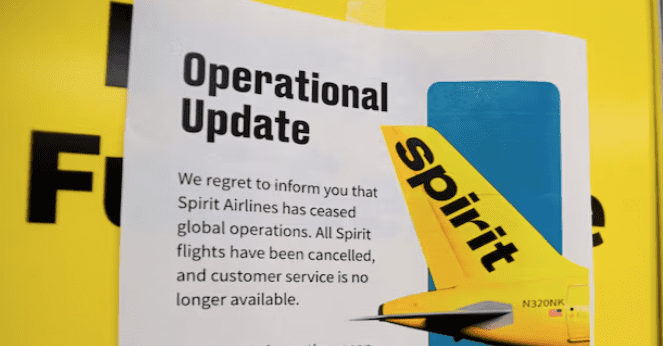
Spirit Airlines’ sudden cessation of operations isn’t just a blow to travelers; it’s a gut-punch realization for supply chain professionals everywhere. Forget the press releases and polished PowerPoints. This isn’t about a bad quarter; it’s about the fundamental fragility of networks built for an imagined, stable world. When demand swings, labor gets scarce, and costs spiral, the highly tuned machines we’ve meticulously constructed start to seize up. And that, my friends, is precisely what happened to Spirit.
Let’s be clear: Spirit’s low-cost model wasn’t inherently flawed. It was a brilliantly executed strategy, expanding air travel access by stripping away the ‘frills’ and pushing utilization to the absolute limit. Think about it: high aircraft utilization, razor-thin unit costs, tight schedules, and a customer base inherently sensitive to price. Sound familiar? It should. These are the very principles many of our own supply chains are built upon – lean inventory, consolidated shipping, maximum asset uptime, and relentless cost reduction. These choices sing when the economic forecast is sunny and predictable. They croak when the weather turns foul.
The airline industry lays bare the interconnectedness of complex systems. An aircraft isn’t just a metal tube; it’s a critical node in a vast, time-sensitive network. A single delay—a maintenance hiccup, a crew missing a connection, a weather anomaly—can ripple outward, snagging multiple subsequent flights. When enough of these ‘small’ problems accumulate, the entire operation grinds to a halt. Supply chains operate on the exact same principle, even if the dependencies are less immediately obvious. A single supplier missing a shipment, a production line faltering for an hour, a port congestion event—these aren’t isolated incidents. They are dominoes waiting to fall, triggering downstream bottlenecks and cascading failures that can cripple delivery performance and customer satisfaction.
And here’s where most companies, much like Spirit, miss the mark. They obsess over visibility—dashboards, control towers, real-time tracking. They know something is going wrong. They have alerts firing, shipments flagged, inventory levels flashing red. The real problem, however, isn’t a lack of data. It’s a deficit in decision architecture. What do you do when every single option comes with a hefty price tag – higher freight costs, service penalties, regulatory entanglements, or alienating a key customer? That’s the core supply chain dilemma.
Do you expedite that crucial shipment, burning cash to meet a deadline, or do you accept the delay and risk losing the customer’s goodwill? Do you reroute precious inventory to one region and leave another high and dry? Do you shift production to a new facility, only to create a different choke point? These aren’t questions of data availability; they are agonizingly constrained choices.
This is precisely why the next frontier in supply chain performance won’t be another fancy dashboard. It’s going to be about building systems and processes that can rapidly evaluate trade-offs, understand the cross-functional fallout of decisions, and orchestrate coordinated actions across planning, procurement, operations, and sales. It’s about moving beyond just seeing the problem to actually solving it, fast.
Spirit’s shutdown illustrates the critical difference between buffer and optionality. Buffer is excess capacity, inventory, or time. Optionality is the ability to reconfigure the network when the original plan no longer works.
In supply chain terms, optionality might look like pre-vetted alternate suppliers, flexible routing options, dynamic inventory positioning that can shift on a dime, or the ability to reallocate production capacity before a constraint becomes a customer-facing failure. But even with theoretical options, true optionality requires empowered decision-making. A company can have all the contingency plans in the world and still fail if it’s too slow, too siloed, or too rigidly attached to the original, now-obsolete, plan.
Furthermore, financial resilience plays a huge role. A business model predicated on maximum utilization and razor-thin margins simply cannot absorb the shock of unexpected cost increases, sudden demand shifts, or degraded service levels. Supply chains face the same vulnerability. When cost targets leave no room for variability, the network might look incredibly efficient on paper, but operationally, it’s a house of cards.
The market will, eventually, adjust. Other airlines will absorb Spirit’s routes, passenger pricing will recalibrate, and travelers will find new ways to get from A to B. This is the natural rebalancing of networked economies. But system-level adaptation does little for the individual firm that can no longer operate. The same pattern plays out in supply chains: a supplier falters, alternatives eventually emerge, capacity shifts, customers adapt. The broader system weathers the storm over time. The company that neglected resilience, however, bears the brunt of the initial impact.
The takeaway isn’t to discard efficiency altogether. That would be foolish. The lesson is that efficiency must be engineered for a world that is anything but stable. A more enduring operating model isn’t just about maximizing utilization; it’s about finding the right balance with flexibility. It requires a keen eye for where a network is too tightly coupled, where minor disruptions can trigger seismic shocks, and where decision-making latency needs to be slashed. It demands that operators be given more than just visibility; they need the actual ability to act, decisively and swiftly.
The Spirit Airlines shutdown is more than just an airline failure; it’s a potent, real-world case study for every supply chain leader who’s prioritized lean over resilient. The era of hyper-optimization without a strong backup plan is over.
Why Does Spirit Airlines’ Shutdown Matter for Supply Chains?
Spirit Airlines’ abrupt shutdown serves as a potent allegory for supply chains that have been optimized for efficiency at the expense of resilience. The airline’s business model, much like many modern supply chain strategies, relied on high utilization, tight scheduling, and minimal slack. When external factors like rising costs, labor shortages, and fluctuating demand outpaced the rigid operating model, the system collapsed. This highlights that while efficiency drives profitability in stable times, it creates significant vulnerability when variability increases. Supply chain leaders must recognize that hyper-optimized networks, while appearing cost-effective, are often brittle and ill-equipped to handle the inevitable disruptions of the real world.
What’s the Difference Between Buffer and Optionality in Supply Chains?
Buffer in a supply chain refers to tangible excess resources like inventory, capacity, or time deliberately held to absorb disruptions. Think of it as a safety net. Optionality, on the other hand, is the inherent ability of the network to adapt and reconfigure itself when the original plan fails. This includes having alternative suppliers, flexible logistics routes, dynamic inventory positioning capabilities, and the organizational agility to shift production or resources quickly. While buffer provides a cushion, optionality offers a path forward when the cushion is insufficient or no longer relevant. Spirit’s situation shows a lack of optionality – they couldn’t reconfigure when their core assumptions broke down.
🧬 Related Insights
- Read more: El Niño Stalks Panama Canal Again as Middle East Air Freight Sits Out Ceasefire Hype
- Read more: Tenet and Crown Merge: What it Means for Your Shipments
Frequently Asked Questions
What does Spirit Airlines’ shutdown reveal about supply chains?
It reveals that supply chains optimized solely for efficiency and high utilization become brittle and prone to collapse when faced with disruptions like demand shifts, cost increases, or labor shortages. Resilience through optionality is now more critical than pure cost reduction.
Will this lead to more resilient supply chains?
Ideally, yes. The Spirit Airlines example should serve as a strong warning, prompting businesses to re-evaluate their supply chain designs, invest in flexibility, and build better decision architectures that can handle trade-offs under pressure, rather than relying purely on visibility tools.
Is a focus on low-cost operations inherently bad for supply chains?
No, a focus on low-cost operations isn’t inherently bad, but it becomes a significant risk when it’s the only focus. It must be balanced with resilience, flexibility, and the ability to adapt. When cost savings leave no room for variance or unexpected events, it becomes a dangerous strategy.