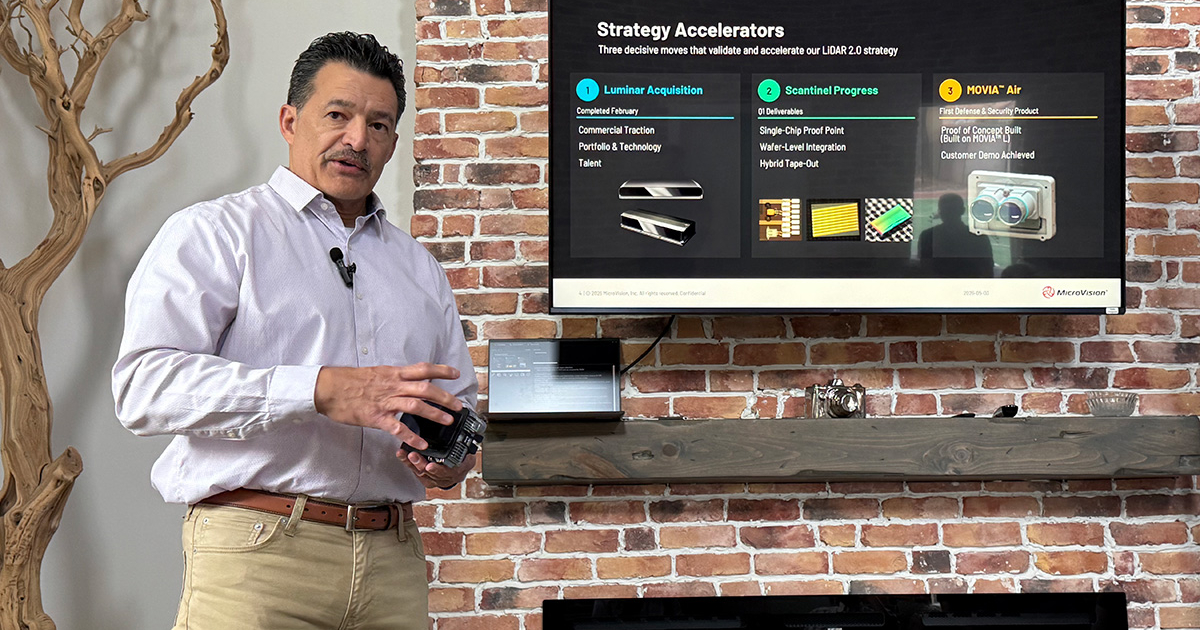
A dust-covered bankruptcy auction gavel fell, and MicroVision walked away with Luminar’s lidar assets. Then they nabbed Scantinel Photonics for good measure. Now they’ve got a pile of tech and a big announcement: it’s time for “lidar 2.0.”
Look, lidar’s been around. It’s the fancy laser doodad that lets self-driving cars see. The problem? It cost a fortune. Like, a really expensive fortune. So, limited trucks and maybe a few robotaxis got the privilege. The rest of us? Not so much.
MicroVision’s plan? Cut the cost. They’re talking $200 sensors down the line. That’s a steep dive from current prices. They snagged Luminar’s long-range Halo and Iris sensors. Plus, Scantinel’s ultra-long-range tech for commercial vehicles. It’s a two-pronged attack: acquire the goods, then engineer them down to earth.
The “Lidar 2.0” Pitch
Greg Scharenbroch, MicroVision’s VP of engineering, is the guy selling this vision. He basically said previous lidar was “cool, but too expensive.” His new mantra is “design to cost.” It’s not rocket science, but for lidar, it might as well be.
He also stressed reusability. “All of this is reusable for commercial vehicles,” he claims. It’s about adapting the core tech – detecting, tracking, classifying objects – for everything from passenger cars to autonomous forklifts and even military drones. One tech, many uses. Simple, in theory.
But here’s the kicker: is this actually new, or just a repackaging of old problems with new PR speak? “Lidar 2.0” sounds a lot like the same promises we’ve heard for years. Making expensive tech cheaper is the perpetual motion machine of the tech industry. Often, it’s just marketing.
MicroVision did show off some impressive demos. They mapped a route and pinpointed a car’s location without GPS, using just their lidar. That’s neat. It shows the tech works. The question is whether MicroVision can actually execute on the cost reduction and broad adoption they’re promising. This isn’t just about shiny sensors; it’s about making them ubiquitous.
History is littered with companies that promised to democratize advanced tech. Most of them ended up as footnotes. MicroVision’s acquisitions are bold. Their strategy is clear. But “lidar 2.0” needs more than just clever naming. It needs tangible, affordable products hitting the market. The ACT Expo crowd will be watching. We all should be.
MicroVision’s gamble on acquiring technology, rather than solely developing it in-house, mirrors a trend seen across various tech sectors. It’s a faster path to market, sure, but it also means integrating different development cultures and legacy intellectual property, which can introduce unforeseen complexities and delays. The success of their “lidar 2.0” hinges not just on price, but on how smoothly they can meld these acquired pieces into a cohesive, cost-effective whole. It’s a complex dance, and the music has only just started.
What happens to the engineers from Luminar and Scantinel? Are they enthusiastic recruits or reluctant cogs in a new machine? The human element of these acquisitions is often overlooked. When you absorb teams and assets, you also absorb their history, their challenges, and their motivations. MicroVision needs those folks to be fully bought-in, not just for their technical skills, but for their willingness to navigate this new, ambitious landscape. It’s not just about patents and hardware; it’s about people making the tech work.
Is This “Lidar 2.0” Actually Better?
MicroVision claims their approach offers a significant leap forward. By integrating Luminar’s assets and Scantinel’s specialized tech, they’ve broadened their sensor capabilities. The emphasis on a low price point – aiming for $200 per sensor – is indeed a significant differentiator if achievable. Previous generations of lidar were simply too expensive for mass-market adoption in many vehicles. This strategy tackles that core issue head-on. Whether the underlying technology, now under MicroVision’s banner, performs as reliably and safely as its predecessors while being drastically cheaper is the real test.
“We’re going to design to cost,” he said, adding that the company aims to drive down the price of its lidar sensors to $200 in the coming years.
It’s a promise that, if kept, could dramatically alter the landscape for advanced driver-assistance systems (ADAS) and autonomous driving. It’s not just about the luxury car market anymore; it’s about making these safety features accessible across a much wider spectrum of vehicles.
🧬 Related Insights
- Read more: Regional Supply Chains: Globalization’s Slow Fade? [Data]
- Read more: Nestlé’s 414K KitKat Heist Signals Freight Fraud Explosion
Frequently Asked Questions
What does MicroVision do? MicroVision develops lidar sensors and perception software, primarily for advanced driver-assistance systems (ADAS) and autonomous driving applications.
What did MicroVision acquire? MicroVision acquired lidar assets, including sensors and employees, from Luminar Technologies and also acquired Scantinel Photonics.
Will this make lidar cheaper? MicroVision’s stated goal is to reduce lidar sensor costs to around $200 in the coming years by applying a “design to cost” strategy and leveraging acquired technologies.