Humanoid robots are coming.
Seriously. The clunky prototypes you’ve seen kicking around are transitioning from the lab bench to the factory floor, and according to a report from IDTechEx, the market’s about to get interesting. We’re talking a projected $25 billion market by the early 2030s, with nearly 1.8 million units shipping annually by 2036. This isn’t science fiction anymore; it’s an impending supply chain reality, predominantly for automotive manufacturing and, soon after, logistics. Home use? That’s a distant dream for now.
Why the sudden acceleration? The IDTechEx folks point to a confluence of factors: the relentless march toward Industry 5.0 (that shiny, human-centric manufacturing ideal), the explosive progress in embodied AI, and, perhaps most practically, the persistent pressure on labor costs in industrial settings. Unlike the chaotic, unpredictable dance of the real world, factories and warehouses offer a more controlled, predictable environment. Standardized workflows, clearly defined tasks – it’s the kind of place a robot can actually shine, at least initially.
The price tag is the big headline grabber. Imagine a $114,700 humanoid robot in 2024 morphing into a $37,000 model by 2030. That’s a steep dive, a significant enough drop to make some serious ROI calculations start looking a lot more attractive. The supply chain for components is getting nimbler, investor money is flowing, and original equipment manufacturers (OEMs) are clearly betting big.
But Does Cheaper Mean Better Returns?
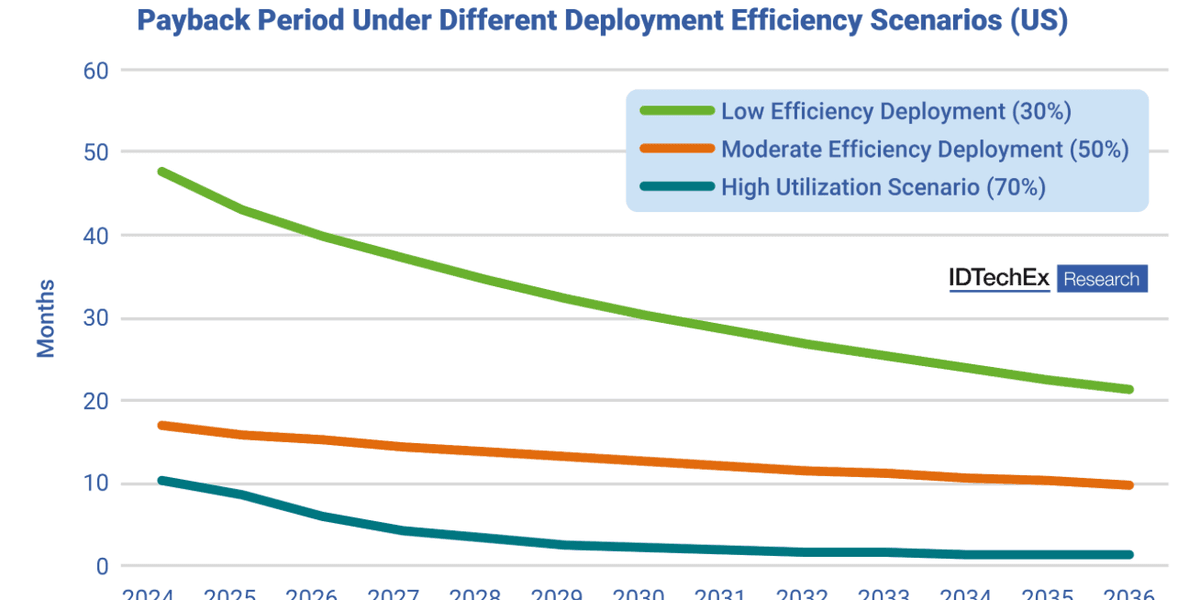
Here’s the kicker, the part where the slick PR often gets glossed over. Even as capital costs crater, the actual payback period for these expensive pieces of hardware is going to be wildly different depending on how you use them. IDTechEx is blunt: lower purchase price is a necessary step, but it’s far from a sufficient condition for widespread adoption.
The problem, as it often is with automation, boils down to utilization. A robot’s hourly cost isn’t directly comparable to a human’s because it demands consistent, high-volume work. It needs task continuity. It requires operational stability. Slap a humanoid robot into a factory doing the same repetitive weld for 16 hours a day, and yeah, the math looks good. Put it in a setting where tasks are sporadic, where the work environment shifts constantly, and suddenly that bargain price starts to look a lot less appealing. The cost advantage shrinks, or worse, disappears entirely. It’s the classic automation dilemma, amplified by the complexity of a bipedal machine.
Is This Industry 5.0’s True Face?
My own take? This rapid cost reduction, coupled with the anticipated boom in demand, feels less like a revolution and more like an evolution turbocharged by AI. We’ve seen this playbook before. Think about the initial cost of industrial robots decades ago – prohibitive for all but the largest players. As technology matured and production scaled, prices fell, and their integration became commonplace. Humanoid robots are simply on that same curve, but the AI and advanced motor control are accelerating the climb. The danger here, and it’s a genuine one, is that the allure of falling prices will lead companies to deploy these machines prematurely into scenarios where they simply can’t operate efficiently. The hype around Industry 5.0, with its emphasis on human-robot collaboration, might inadvertently mask a more hard-nosed economic reality: robots will be deployed where they can do a job cheaper and more consistently than a human, period. And that’s not necessarily a bad thing for productivity, but it’s worth scrutinizing the collaborative aspect when the primary driver is cost substitution.
The IDTechEx report, while forecasting impressive market growth, implicitly warns against a gold rush mentality. Investors and business leaders need to look beyond the unit price and deeply understand the operational parameters. Are your workflows conducive to high-utilization robotics? Can you ensure the task continuity required to make that $37,000 investment truly sing? If not, you might find yourself with a very expensive, very sophisticated paperweight.
🧬 Related Insights
- Read more: TMS Fuels E-Commerce Delivery: AI Boosts Last-Mile Speed
- Read more: Lapp USA Turns Inventory Chaos Into Automation [Drone Tech]
Frequently Asked Questions
Will humanoid robots replace human workers?
While humanoid robots are expected to take over more repetitive and dangerous tasks in manufacturing and logistics, complete replacement of human workers is unlikely in the near to medium term. Their integration will likely lead to shifts in job roles and the need for new skill sets rather than mass unemployment.
What are the biggest challenges for humanoid robot adoption?
Beyond cost, key challenges include ensuring sufficient utilization rates, maintaining task continuity, guaranteeing operational stability in varied environments, and developing the necessary infrastructure and safety protocols for widespread deployment. AI limitations in truly unpredictable situations also remain a hurdle.
When will humanoid robots be common in homes?
IDTechEx’s forecast suggests home-use applications for humanoid robots are a longer-term opportunity. Significant penetration within their forecast period (up to 2036) is limited, indicating that widespread adoption in domestic settings will likely take longer due to environmental complexity and cost-effectiveness challenges.