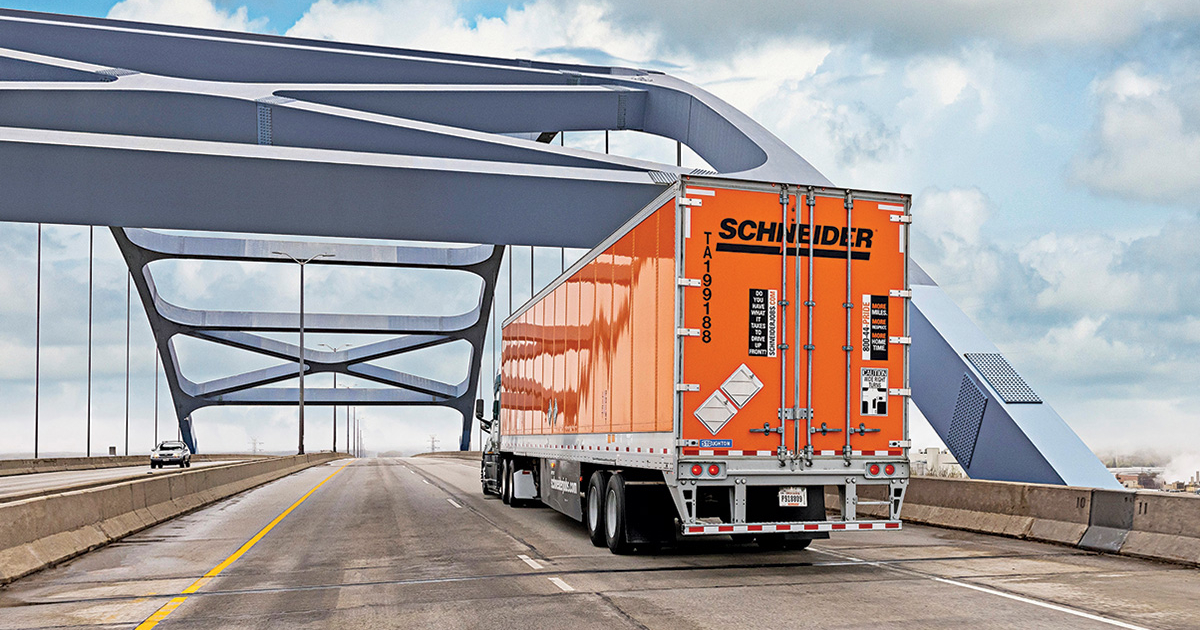
So, what does this all mean for you? Forget the quarterly earnings reports for a second. This is about the quiet hum of trucks on the highway, the predictable arrival of your online order, the very rhythm of commerce. When a company like Schneider, a titan in the logistics world, whispers about an “upcycle” taking hold, it’s not just industry jargon. It’s a signal that the bumpy, unpredictable ride of the past few years might be smoothing out, potentially meaning more stable pricing and, dare I say it, a touch more predictability in the goods you rely on every single day. We’re talking about a fundamental shift, like when the internet went from dial-up to broadband – a leap in capability and experience for everyone involved.
Schneider’s recent Q1 earnings report lands with a bit of a thud financially – flat revenue and lower year-over-year earnings. On the surface, it’s easy to shrug. But look closer. Beneath that seemingly stagnant surface, a powerful undercurrent is building. CEO Mark Rourke isn’t just whistling past the graveyard; he’s pointing to a market rebalancing. He believes regulatory enforcement, particularly around driver proficiency and licensing, is doing what the market alone couldn’t quite achieve: it’s systematically, and perhaps permanently, thinning out the herd of available trucks.
This isn’t just about fewer trucks. It’s about a market responding to fundamental supply and demand forces, amplified by a dose of necessary regulatory discipline. Think of it like this: for years, the freight market was like a sprawling, overcrowded amusement park with too many rides and not enough demand for them. Now, some rides are being retired, and while it might feel a little less chaotic initially, it’s paving the way for a more structured, potentially more profitable experience for the remaining operators. And in turn, for the businesses that depend on them.
Is This AI’s Invisible Hand at Play? (Not Exactly, But Close)
While the article doesn’t explicitly mention AI, it’s impossible to ignore the parallels. The DOT’s stricter enforcement, pushing out less compliant or less efficient operators, feels like a crude, human-driven version of an AI optimization algorithm. It’s pruning the inefficiencies. The result? A leaner, potentially more responsive system. We’re not seeing a neural network predicting truck availability here, but the effect of removing friction and irrational exuberance from the system is the same. It’s a reminder that even in a physical industry like trucking, smart regulation can act as a powerful catalyst for recalibration, much like intelligent algorithms can refine digital processes.
Jim Filter, group president of transportation and logistics, echoes Rourke’s sentiment, noting that the market momentum exiting 2025 has only strengthened. He attributes this not just to weather disruptions but to the “capacity attrition we have seen over the last several quarters.” This isn’t a sudden storm; it’s a gradual, structural shift. The Department of Transportation’s increased enforcement, specifically targeting English-language proficiency and the issuance of non-domiciled commercial driver licenses, is acting as a significant scalpel, carving away at the excess capacity that had, for a time, depressed rates.
Filter’s outlook is fascinatingly nuanced. He anticipates more capacity leaving the market, not less. Fuel cost inflation and the upcoming International Roadcheck are poised to be further catalysts for drivers to make permanent exits. This isn’t fear-mongering; it’s a realistic assessment of the pressures on smaller operators. The hope is that these reductions will bring the market back to what he calls “more normal conditions.” What does that mean? Likely, a more balanced playing field where capacity is priced appropriately for the service provided.
“The market is seeing increasingly reduced capacity at a time when spot prices are recovering. As a result, many cycle indicators, such as tender rejections, spot contract spreads and fleet utilization flash green in the first quarter with some of these signals at levels last seen during the pandemic.”
These aren’t just abstract market indicators. Tender rejections flashing green mean that shippers are having a harder time getting their loads picked up on the first try – a classic sign of tightness. Spot contract spreads widening signal that the difference between immediate, spot market rates and longer-term contract rates is growing, often indicating increased demand pressure on immediate needs. Fleet utilization climbing means trucks are spending less time idle and more time moving goods. These are the real-world manifestations of a market tightening.
However, Filter also injects a dose of caution, acknowledging the lingering macro uncertainty, inflation expectations, and the dimming prospects for further interest rate cuts. These factors could still inject demand risks later in the year. It’s a classic supply chain balancing act – the supply side is tightening, but the demand side still has its own set of variables.
What This Means Beyond the Boardroom
For the average consumer, this could translate into a gradual stabilization of shipping costs, and perhaps more importantly, a reduction in the kind of wild price swings we’ve seen. Businesses, especially smaller ones that rely on predictable logistics, might finally see a clearer path forward. It’s the difference between navigating a foggy, unpredictable highway and driving on a well-lit, well-maintained road. This upcycle, if it truly solidifies, is about re-establishing a baseline of efficiency and fair pricing, a much-needed recalibration after a period of significant upheaval.
Revenue by Segment Analysis: A Tale of Differing Fortunes
While the overall picture is one of cautious optimism, the breakdown by segment tells a more detailed story. Truckload revenue saw a modest 1% increase, reaching $618 million. However, income from operations in this crucial segment dipped by a significant 20%, landing at $20.2 million. This suggests that while demand might be holding steady or slightly improving, the costs of providing that service are eating into profitability.
Intermodal, a mode that often balances cost and efficiency for longer hauls, saw a 3% decrease in revenue to $253.5 million, with income from operations falling 21% to $10.9 million. This segment appears to be facing more pronounced headwinds, perhaps due to shifting modal preferences or increased competition.
Logistics, which encompasses a broader range of services beyond just moving freight, experienced the steepest revenue decline at 6%, bringing in $312.3 million. Income from operations here also saw a substantial 20% drop to $6.5 million. This might indicate a need for strategic adjustments within their logistics offerings to better align with current market demands and cost structures.
Despite these segment-specific challenges, Schneider’s overall performance and outlook on the freight upcycle speak to a resilient industry adapting to new realities. The company’s position as a top-ranked player on industry lists underscores its significance, and its CEO’s forward-looking perspective offers a compelling glimpse into the potential future of freight movement.
🧬 Related Insights
- Read more: 26% of Carriers Eye AI to Boot Freight Brokers
- Read more: FedEx’s Reusable Boxes Hit the Road: From Pilot to Potential Supply Chain Overhaul
Frequently Asked Questions
What is a freight upcycle? A freight upcycle refers to a period in the transportation industry where demand for shipping services outstrips available capacity. This typically leads to increased freight rates, improved profitability for carriers, and a general strengthening of the market for logistics providers.
Will this upcycle lead to higher shipping costs for consumers? While an upcycle generally means higher rates for carriers, the impact on consumer prices can be indirect and gradual. Businesses may absorb some increased costs, while others might pass on a portion to consumers, but it’s unlikely to be an immediate, drastic jump. Stability and predictability are often the more immediate benefits.
Does regulatory enforcement truly cause capacity attrition? Yes, regulatory enforcement can significantly impact capacity. When regulations become stricter, particularly regarding safety, driver qualifications, or operational compliance, some carriers or drivers may be unable or unwilling to meet the new standards, leading them to exit the market. This reduces the overall available capacity.