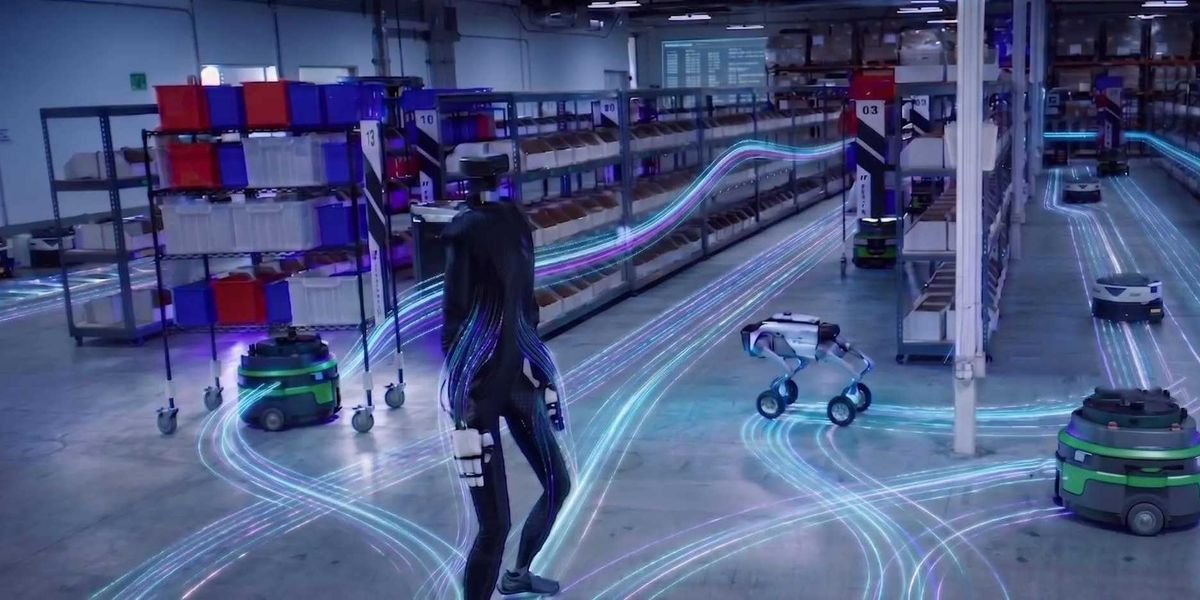
Is your warehouse still thinking in terms of conveyor belts and simple commands? If so, you’re probably falling behind.
For decades, Warehouse Control Systems (WCS) were the undisputed kings of the castle, diligently directing traffic for fixed automation like sorters and conveyors. They did their job, and for a simpler era, they did it well. But let’s be blunt: the warehouse landscape has morphed into something far more complex, a chaotic ballet of Autonomous Mobile Robots (AMRs), automated storage and retrieval systems (AS/RS), vision systems, Warehouse Management Systems (WMS), and a perpetually fluctuating human element, all grappling with an ever-growing stream of exceptions. This isn’t your grandfather’s warehouse anymore, and clinging to outdated control paradigms is a recipe for operational gridlock.
The core of the issue lies in a fundamental shift: the gravity center is moving from mere control to actual orchestration. This isn’t just semantic rebranding; it represents a seismic change in how warehouse software functions. Instead of just telling machines what to do, this new breed of software is actively making real-time decisions about how work gets prioritized, how tasks are routed, how resources are balanced, and crucially, how disruptions are managed and recovered from across the entire operation. It’s the difference between a conductor telling individual musicians when to play a note and a maestro guiding an entire symphony to create a cohesive, dynamic performance.
Executive Takeaway: The industry’s moving from equipment command-and-control (WCS) to real-time decision-making that smoothly integrates people, robots, and exception handling. Orchestration software is emerging as the critical layer for coordinating priorities, routing, and recovery, ultimately transforming automation into a strategic, system-wide advantage. Leaders must now assess orchestration not as an afterthought, but as a foundational component of their warehouse technology stack.
The Crumbling Foundation of Traditional WCS
Traditional WCS was designed for a world that largely doesn’t exist anymore – a world of predictable physical pathways and straightforward logic. Its strength was in executing deterministic tasks: scan here, divert there, keep the line moving. But today’s warehouses are anything but predictable. We’re dealing with a volatile mix of order profiles, fluctuating labor availability, diverse robot fleets, constantly shifting inventory locations, and a relentless onslaught of exceptions that defy simple rule-based processing. This creates a chasm between what the hardware can do and what operations need it to do. A WCS can execute a command, yes, but it’s often incapable of optimizing across labor, robots, inventory levels, service level agreements (SLAs), and real-time congestion simultaneously. As facilities pile on more automation, this gap becomes the primary bottleneck, stifling potential gains.
What “Orchestration” Really Means in Practice
So, what is this nebulous concept of orchestration? It’s the intelligent layer that transforms a collection of disparate tools into a truly coordinated, intelligent system. It’s the software that dynamically assigns work, fluidly shifts tasks between human associates and robots, adeptly reacts to unexpected delays, and keeps the operational flow moving even when plans go awry. In the modern tech stack, orchestration acts as the central nervous system, sitting above the WMS (which plans work) and WES (which sequences it within defined areas), and alongside or even superseding the WCS, to coordinate critical decisions continuously, not in clunky batches. Think of it as the brain that constantly re-evaluates the entire body’s needs based on immediate feedback.
This constant re-evaluation is paramount because the warehouse floor is now a minefield of interdependent choices. A late inbound shipment? Should labor be reallocated? An AMR queue is backing up? The system needs to reroute tasks now. Congestion in an AS/RS aisle? Which work should be de-prioritized without tanking overall throughput? Orchestration provides the rapid-fire logic to answer these questions before they cripple the operation. A stark example can be seen in AMR-heavy environments, where hundreds of micro-decisions per hour dictate whether the facility hums or grinds to a halt. Companies like Locus Robotics are showcasing this in the wild with their LocusOne platform, which doesn’t just deploy robots but actively coordinates them with human workflows, assigning tasks, balancing labor, and optimizing routes in real time. This is where automation truly becomes a system-level advantage, not just a collection of expensive toys.
Why AI is Suddenly Crucial for Warehouse Smarts
And this is precisely why Artificial Intelligence (AI) is no longer a buzzword but a necessity for effective orchestration. Orchestration, by its very nature, requires nuanced judgment under constantly shifting conditions. The leading systems are now embedding AI to dynamically manage workload balancing, predict optimal slotting locations, proactively handle exceptions, and implement adaptive routing. This isn’t about creating fully autonomous, lights-out operations overnight—though that’s the long-term trajectory. It’s about empowering the software to make significantly better, more informed decisions with minimal human intervention, especially in complex, dynamic environments populated by AMRs and modular automation. The true value isn’t just in deploying the robots; it’s in their intelligent integration, making the entire operation more resilient and efficient. The robot, in this new paradigm, is merely the muscle; orchestration is the brain.
The Evolving Warehouse Software Stack
The modern warehouse technology stack is rapidly coalescing around a layered approach:
-
WMS: Plans work based on demand, inventory data, and incoming orders.
-
WES: Sequences and releases tasks to maintain process flow within defined areas.
-
WCS: Executes low-level equipment control and device commands.
-
Orchestration: Optimizes cross-functional decisions in real-time, coordinating labor, robots, automation, and exception management.
This isn’t just an academic exercise in software architecture; it reflects a fundamental shift towards connected, cloud-native, API-driven operations that are agile enough to adapt to business needs. The warehouse is becoming a software-defined ecosystem, and orchestration is its operating system. The business case is becoming undeniable: increased throughput, reduced errors, better labor utilization, and enhanced adaptability in the face of disruption.
So, the question isn’t if orchestration is coming to your warehouse; it’s when and how you’ll implement it. The companies that embrace this shift will likely be the ones thriving in the increasingly complex logistics landscape of tomorrow.
Is Orchestration Just a Fancy WMS Update?
No, not quite. While a WMS focuses on managing inventory and orders, orchestration is about the dynamic execution and optimization of tasks across various resources (people, robots, machines) in real-time. It acts as a layer above or alongside the WMS, making intelligent, adaptive decisions based on current conditions rather than static plans. Think of the WMS as the planner and orchestration as the agile, real-time battlefield commander.
Will This Software Replace Warehouse Workers?
This is the million-dollar question, isn’t it? Orchestration software aims to optimize human labor alongside automation, not necessarily replace it entirely. By intelligently assigning tasks, managing workloads, and handling exceptions, it can make existing staff more productive and allow them to focus on higher-value activities. However, as operations become more automated and efficient due to these systems, the overall need for manual labor in certain roles might decrease. It’s more likely to shift the nature of warehouse jobs than eliminate them outright, demanding new skills in managing and overseeing these sophisticated systems.
What’s the Difference Between WES and Orchestration?
A Warehouse Execution System (WES) typically focuses on releasing and sequencing work within a defined process area or automation system. Orchestration, as discussed, operates at a higher, broader level. It’s about cross-domain coordination across all process areas and resources (labor, robots, all types of automation) with continuous re-optimization as conditions change. While a WES might manage the flow within a pick module, orchestration decides whether picking should happen there at all, or if labor should be diverted elsewhere due to a problem in receiving.