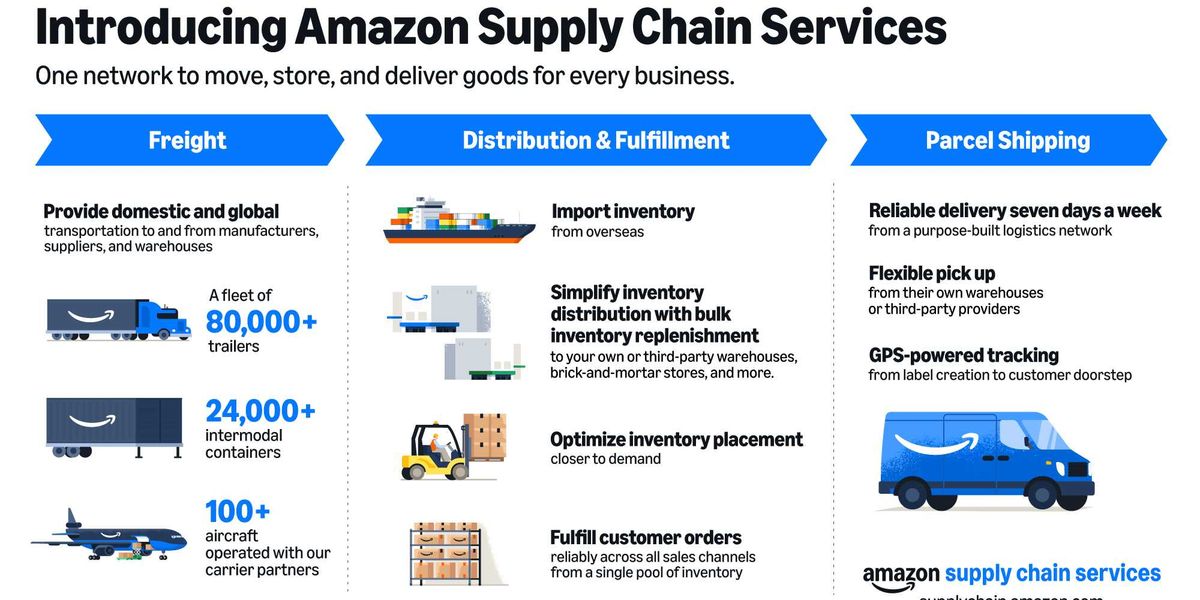
The image of boxes zipping through Amazon’s colossal fulfillment centers, a seemingly impenetrable fortress of efficiency, is now… permeable. Amazon Supply Chain Services, encompassing freight, distribution, fulfillment, and parcel delivery, is no longer solely for its own retail empire or its third-party sellers. It’s officially open for business, inviting any company, big or small, to tap into its vast logistical infrastructure. We’re talking about everyone from Fortune 500 giants like 3M to apparel brands like Lands’ End already on board. This isn’t just a minor expansion; it’s a strategic pivot that fundamentally alters the competitive landscape.
The economics are, frankly, staggering. Amazon commands a network built on decades of relentless investment and data-driven optimization. The sheer scale of its operations, from its global fleet of planes and trucks to its ubiquitous warehousing and last-mile delivery capabilities, represents a formidable moat. By opening this up, Amazon isn’t just selling a service; it’s selling access to an entire, finely tuned ecosystem. For businesses that have struggled with the escalating costs and complexities of managing their own supply chains, or even with the unpredictable capacity of traditional 3PLs, this presents a compelling, if potentially daunting, alternative.
But is this a genuine open market, or a calculated move to further entrench Amazon’s dominance? The company’s PR machine would have you believe it’s about democratizing logistics, providing essential services to the broader business community. Yet, the data suggests a more Machiavellian play. Amazon has always excelled at identifying underserved markets and then systematically devouring them. Think about how AWS emerged from Amazon’s internal infrastructure needs. This feels eerily similar.
Why Should Established Logistics Players Be Concerned?
The implications for traditional carriers, freight forwarders, and even major 3PLs are significant. These companies have spent years building relationships, negotiating contracts, and investing in their own assets. Now, a competitor that simultaneously operates as a massive retail platform and a logistics provider is directly competing for their customer base, and crucially, with infrastructure that likely carries a lower per-unit cost due to its massive, optimized scale. It’s like a giant opening its pantry to the neighborhood – everyone else is suddenly eyeing the competition with a lot more urgency.
We’ve seen this play before, albeit on a smaller scale. When Amazon started offering its fulfillment services to third-party sellers on its platform, it wasn’t just about making those sellers more efficient; it was about capturing a larger share of the shipping revenue and, critically, gaining even more data on consumer purchasing habits and delivery times. Expanding this outward, to any business, magnifies that data advantage exponentially.
Amazon’s move to open its logistics network to all businesses represents a bold new phase in its evolution from e-commerce giant to a full-service supply chain provider.
This isn’t just about parcel delivery. Amazon is talking about full-freight services, warehousing, and distribution. For a company that operates its own air cargo fleet and has invested billions in automation and robotics within its warehouses, offering these services externally is a logical, albeit aggressive, next step. The question for other businesses becomes: can you afford to not explore this option, even if just for a pilot program?
The Data Behind the Disruption
Look at the numbers. Amazon’s logistics spending has been astronomical, driven by the demands of its own marketplace. Reports indicate Amazon spends tens of billions annually on its supply chain operations. By monetizing a portion of this capacity, even if it doesn’t fill their entire network, they create new revenue streams while simultaneously squeezing competitors who don’t have the same foundational scale. It’s a classic example of capturing more of the value chain.
Furthermore, the data Amazon will acquire from these external partnerships will be invaluable. Understanding the shipping patterns, inventory management needs, and distribution challenges of diverse industries will provide Amazon with an unparalleled dataset. This intelligence can then be fed back into optimizing their own retail operations, developing new logistics technologies, and identifying further market opportunities.
Consider the historical parallel of John D. Rockefeller and the Standard Oil Company. He didn’t just refine oil; he controlled the pipelines, the shipping, and the distribution, effectively controlling the entire industry by dominating each interconnected component. Amazon, in its own modern, digital way, is attempting a similar feat with the physical movement of goods.
This strategic maneuver isn’t merely about offering competitive pricing; it’s about fundamentally redefining what it means to be a logistics partner in the 21st century. The established players need to demonstrate not just efficiency and reliability, but innovation and adaptability. The game has changed, and Amazon has just moved the board.