For the truck driver hauling a load across state lines, or the warehouse manager bracing for a critical delivery, the daily reality of transportation isn’t dictated by algorithms alone. It’s shaped by the hard-won, often unwritten rules of experienced dispatchers who navigate a chaotic mix of data, exceptions, and sheer human intuition. This human element, often overlooked in the race for pure optimization, is precisely where Logicplan is planting its flag.
Let’s be clear: the promise of Transportation Management Systems (TMS) has always been about bringing order to the freight world. Feed it the orders, the trucks, the delivery windows, the costs, and out pops a perfect plan. And yes, for highly standardized, predictable operations, that can work. But the messy truth, as a recent deep dive with Logicplan co-founder Luuk Kuijpers revealed, is that in the real trenches of mid-market transportation—think specialized hauling, LTL, and groupage—the actual planning system is often still the dispatcher’s brain.
The Human in the Loop: More Than Just Data Entry
Logicplan’s genesis wasn’t in a sterile boardroom; it emerged from painstaking field research. Kuijpers and his team spoke with over 50 dispatchers, the unsung heroes of freight. What they found wasn’t a clean, data-rich environment. Instead, it was a whirlwind of fragmented information: TMS screens, yes, but also spreadsheets, an unending stream of emails, WhatsApp messages, customer calls, and crucially, the dispatcher’s own vast reservoir of experience. These aren’t just route builders; they’re crisis managers, coordinating operations under relentless time pressure.
An experienced dispatcher just knows. They know which customer will grumble but accept a delayed delivery, which driver can handle a particularly tricky drop-off, which anomaly demands immediate escalation, and which seemingly ironclad constraint can be creatively sidestepped. This knowledge, accumulated over years of wrestling with thousands of exceptions, is gold. Yet, it often resides solely in their heads, making them indispensable but also a significant single point of failure.
Beyond Pure Optimization: The Judgment Factor
Logicplan is pushing back against the notion that every transportation puzzle is a pure mathematical optimization problem. While solvers are potent when operations are uniform and constraints are rigidly defined, Logicplan targets a different beast. Their focus is on mid-sized companies where planning inherently relies on context-specific judgment.
In these environments, even with sophisticated automation tools at their disposal, planners often resort to manual processes. This isn’t necessarily a indictment of the tools themselves, but a signal that the tools might not be capturing enough of the vital operating context. The planner isn’t just crunching numbers; they’re recognizing patterns, drawing on historical precedents, and making educated guesses that go beyond simple calculation.
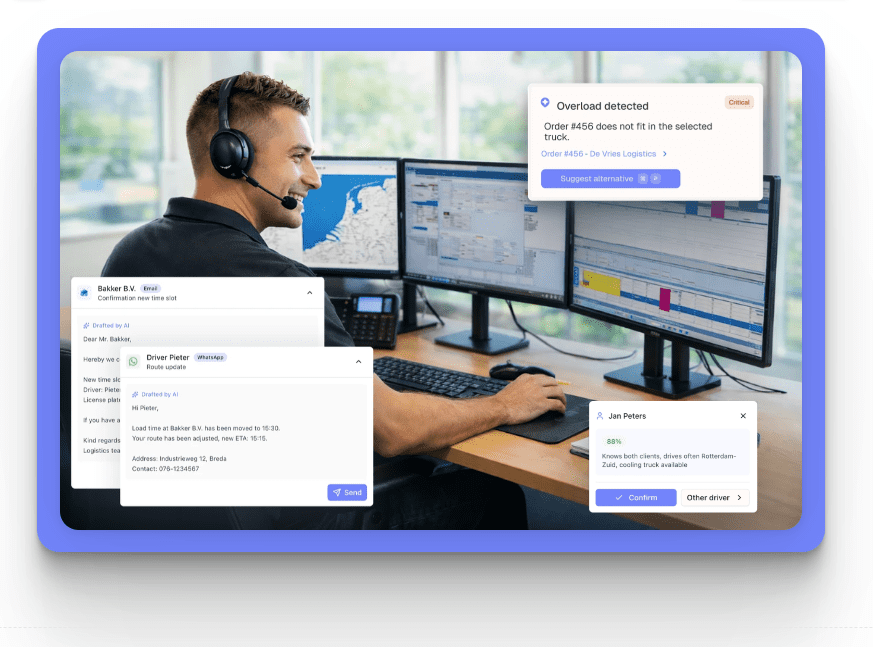
Logicplan isn’t aiming to dismantle the existing TMS infrastructure; that’s a non-starter. Kuijpers was emphatic on this point. The TMS remains the bedrock of operational execution. Instead, Logicplan positions itself as an “intelligence and execution layer” that sits above and alongside the TMS. Its function is to integrate with existing systems, build out that missing operational context, and crucially, empower dispatchers in their decision-making. This could mean surfacing intelligent recommendations or facilitating interactive problem-solving during disruptions.
The long-term vision? As the system accumulates more context and decision history, greater automation becomes feasible. But the immediate, tangible value lies not in replacing the dispatcher, but in making their seasoned judgment more transferable and scalable across the organization.
The Elusive Art of Knowledge Capture
Connecting to a TMS is, relatively speaking, the easy part. The real challenge lies in capturing judgment. A truly effective decision support system needs to understand not just what decision was made, but why it was the right one at that specific moment. What was the operating environment? What alternatives were even considered? What did the planner know about the customer, the driver, the specific shipment, or a previous similar exception?
This matters profoundly because so many transportation firms lean on planners whose deep experience is incredibly difficult, if not impossible, to replicate. When these individuals retire, move on, or are simply unavailable, a significant chunk of the company’s operational logic walks out the door with them. That’s a risk that traditional systems haven’t adequately addressed.
Logicplan, though still in its early stages with pilot customers primarily in the Netherlands and eyeing European expansion, is tackling a universal problem in logistics. Transportation planning is often a complex, judgment-intensive process, far removed from a mere system calculation. It’s about understanding the nuances, the exceptions, and the human factors that algorithms alone can’t grasp.
🧬 Related Insights
- Read more: Regional Supply Chains: Globalization’s Slow Fade? [Data]
- Read more: Ocean Rates Surge: What it Means for Your Stuff
Frequently Asked Questions
What exactly does Logicplan do? Logicplan develops software designed to capture and scale the judgment of experienced transportation dispatchers, complementing existing TMS systems by building operational context and supporting decision-making.
Will this replace human dispatchers? Logicplan’s stated goal is not to replace dispatchers but to make their judgment more transferable and scalable, enhancing their capabilities rather than eliminating their role.
Is Logicplan a TMS? No, Logicplan positions itself as a layer above and alongside a TMS, focusing on intelligence and execution rather than replacing the core operational backbone provided by a TMS.