Printer whirs. Layers stack. Boom—a linear motor slides back and forth, alive, electromagnetic heart pulsing.
That’s not some distant lab fantasy. Right now, at MIT, researchers have cracked the code on a 3D-printed motor platform that births functional hardware from raw pellets and inks, no assembly line required. We’re talking a complete electric actuator—conductors firing, magnets pulling, flexibles bending—for about 50 cents in materials and three hours flat.
Zoom out: this isn’t tinkering. It’s a platform shift, like when desktop publishing nuked the need for print shops. Hardware prototyping? Forget factories overseas, snarled in tariffs and delays. Print it local, iterate fast, dodge disruptions. Supply chains, meet your maker.
Why a 3D-Printed Motor Platform Changes Everything for Makers
But here’s the thing—motors aren’t plastic toys. They demand drama: coppery conductors zapping electrons, iron-rich magnets yanking fields, insulators playing gatekeeper, all wrapped in bendy supports. Single-material printers? Useless for that symphony.
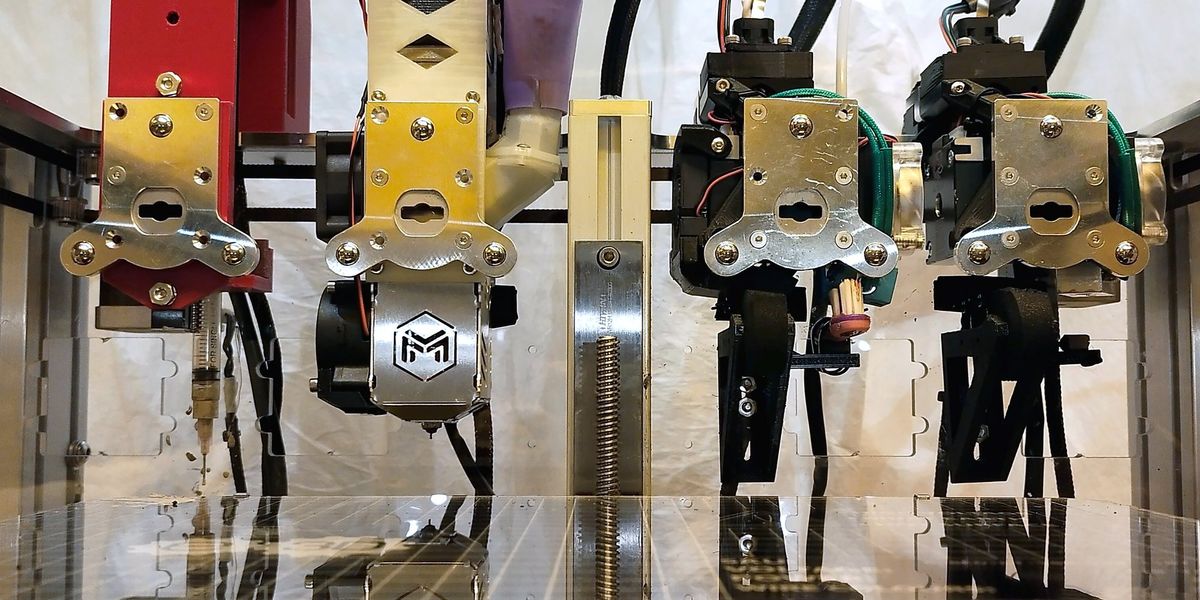
MIT’s squad, led by Luis Fernando Velásquez-García, fused five material classes into one beastly printer. Filament extruder for basics. Pellet extruder—game-changer—for packing magnets dense without snapping. Custom ink squirter for conductivity. Even a heater to cure without melting neighbors.
Pellets, by the way? Genius hack. Filaments choke on particle overload; pellets swallow ‘em whole, birthing stronger magnets. It’s like upgrading from economy rice to a feast—more flavor, no bloat.
And precision? Robotic arms swap tools mid-print, sensors whispering alignments down to microns. One build. One post-magnetize zap. Done.
“Very few applications can be satisfied with just one material,” says Luis Fernando Velásquez-García, principal research scientist at MIT Microsystems Technology Laboratories, who led the study. “If you want to make hardware that actually does something well, it usually requires different materials.”
Spot on. Velásquez-García’s pushing no-compromise materials—clear if optical, conductive if zappy. Why settle for printed mediocrity when factories deliver excellence?
My hot take? This echoes the PC boom: software went from mainframe rarity to bedroom code. Hardware follows—multimaterial 3D printing turns garages into foundries. Bold prediction: by 2030, custom motors for drones, robots, EVs? Desktop-printed, supply-chain-proof.
Can This 3D-Printed Motor Platform Scale to Real-World Chaos?
Linear motors first—sleek sliders for chip fabs, robot arms, MRI gantries. Smooth, precise, no gears grinding.
But rotationals? Car engines, fans, wheels—the heavy hitters? MIT eyes ‘em next. Prototype rig cost a few grand, off-shelf plus custom. Affordable rebellion.
Challenges loom, sure. Cure times clash—inks bake hot, plastics wilt. Layers must kiss perfect, or sparks fly (literally). Yet MIT’s controls nail it, predicting swaps like a chess master.
Skepticism check: is this PR gloss? Nah. Paper in Virtual and Physical Prototyping details the demo motor’s thrust—measurable muscle, not vaporware. Costs plummet versus CNC milling or winding coils by hand.
Picture warehouses: no more hoarding motor variants. Print on demand. EVs tweak torque? Print variant. Robot fails? Print spare. Disruptions—like that chip famine?—irrelevant.
And flexibility—literal and figurative. Soft parts cushion rigid cores, enabling origami-fold actuators or wearables with embedded drive.
Here’s my unique parallel: think Gutenberg’s press democratizing books. This? Democratizing mechatronics. No PhD needed; open-source the files, print worldwide.
How Does Multimaterial 3D Printing Beat Traditional Factories?
Old way: stamp metal, wind coils, cast magnets, glue flex. Steps: dozens. Waste: heaps. Time: weeks.
New way: extrude all-in-one. Cheaper raw stock. Local vibes—no ships from Shenzhen.
Velásquez-García again: “The goal…should be to deliver hardware that does what people want. And if the products can be made with printing, that’s great.”
Win-win, he says. I say revolution.
Energy surges here—imagine AI optimizing designs mid-print, tweaking magnet density for your exact load. Platform shift, remember? AI + printing = hardware as fluid as code.
Short para punch: Scale it.
Now, the dense dive: factories resist because volume rules. But for low-volume, high-mix—like custom prosthetics, satellite actuators, or your garage EV hack—this crushes. Supply chains shrink to filament spools. Geopolitics? Yawn. Pandemic? Print through.
Critique time: MIT’s demo is linear, smallish. Torque for trucks? Not yet. But roadmap screams progress—rotaries incoming.
Wonder spikes: what if we print batteries next? Full powertrains? The future hums electric.
🧬 Related Insights
- Read more: Dems Cool on Trump Impeachment Amid Iran Threats: A Breather for Strapped Supply Chains
- Read more: Pam Bondi Ghosts Congress on Epstein Files Subpoena
Frequently Asked Questions
What is MIT’s 3D-printed motor platform?
A multimaterial 3D printer that builds working linear motors from conductors, magnets, insulators, and flexibles in one three-hour print, using cheap pellets and inks.
Will 3D-printed motors replace factory production?
For prototypes, custom runs, and disruption-proof local manufacturing—yes, fast. Heavy industry volumes? Not yet, but scaling’s the plan.
How much does a 3D-printed motor cost to make?
Raw materials: ~$0.50. Full printer setup: a few thousand bucks. Way under traditional assembly.