The air in the analyst’s office crackled not with innovation, but with the distinct smell of vendor-induced confusion. That’s the reality for many supply chain tech buyers.
The core problem isn’t a dearth of solutions; it’s an absolute glut of overlapping, often nebulous, claims. Planning vendors are now masquerading as orchestration platforms, visibility providers claim to be decision-support engines, and control towers have suddenly discovered AI. Execution platforms promise predictive intelligence, data platforms tout transformation, and the latest generative AI startup insists it can sit atop everything. Some of this is genuine advancement, a good chunk is aspirational, and a fair bit is simply category inflation.
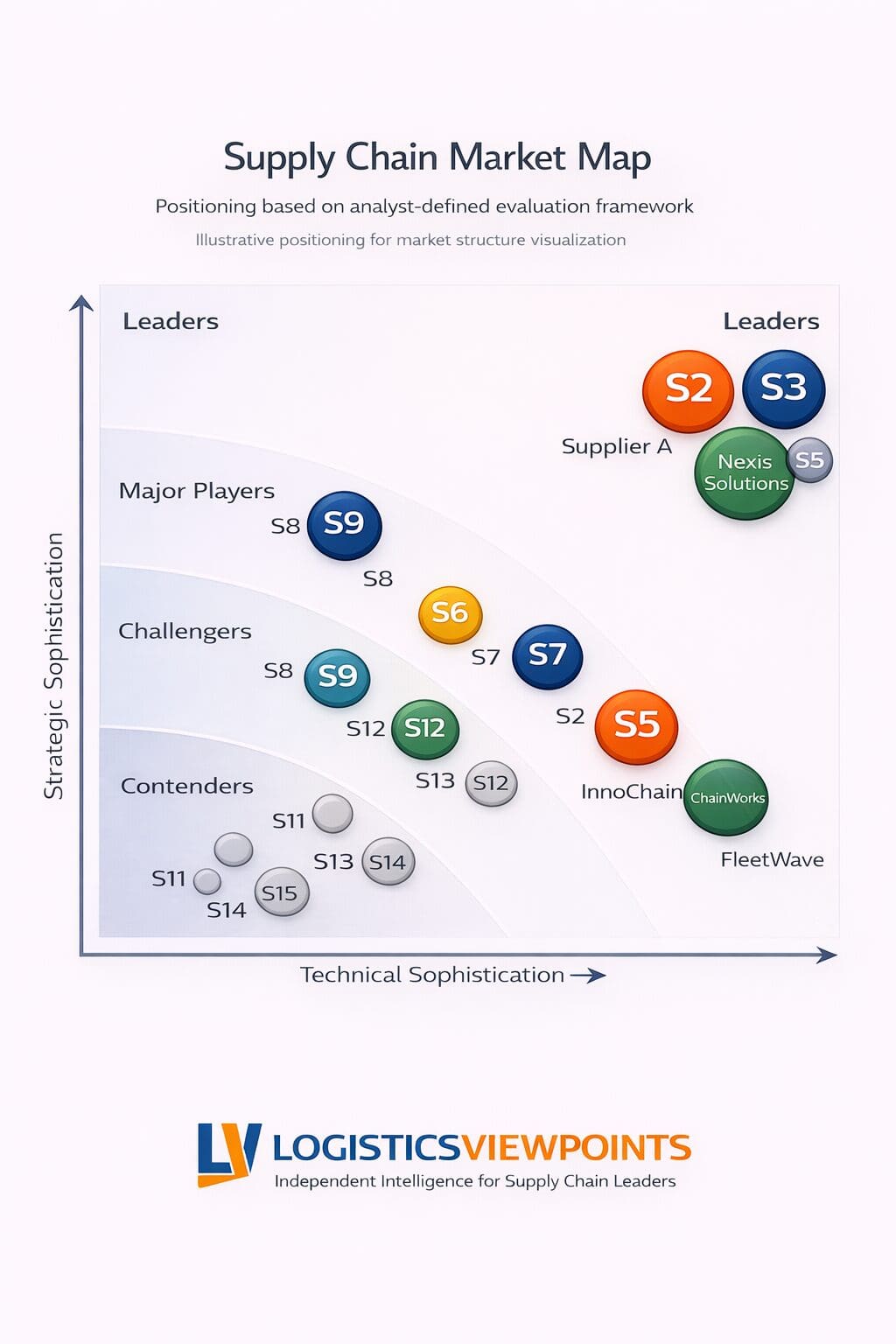
This messy reality is precisely why structured market analysis, like Logistics Viewpoints’ Market Maps, is becoming indispensable. The industry doesn’t need another glossy infographic of logos; it desperately needs clear definitions, distinct market boundaries, and a consistent framework for comparing providers, especially in nascent fields like Supply Chain Decision Intelligence where the language is struggling to keep pace with the technology.
Why Old Categories Still Matter (But Aren’t Enough)
For decades, supply chain technology was neatly compartmentalized: ERP, WMS, TMS, Planning, Procurement, Visibility. These labels still hold weight. A warehouse still requires a WMS, a transportation network still needs a TMS, and planning functions demand dedicated software. These foundational systems are non-negotiable.
However, the true innovation and differentiation are increasingly found above and across these core systems. This is the critical layer where fragmented data gets pieced together, events are contextualized, difficult trade-offs are evaluated, and coordinated responses are orchestrated. It’s the layer that helps supply chain leaders discern what truly matters, what alternatives exist, and what concrete actions should be taken.
This is the fertile ground for Supply Chain Decision Intelligence. This emerging category captures technologies that demonstrably improve how decisions are made across the entire supply chain spectrum – from planning and execution to coordination and disruption management. The fundamental shift is this: leaders don’t just need more systems; they need demonstrably better decision-making performance across those systems.
Visibility Was Just the Beginning
The last decade of supply chain software development was largely defined by the relentless pursuit of visibility. And, to be sure, it was a necessary endeavor. Companies needed to know where their shipments were, how much inventory they held, who their suppliers were, the status of their orders, the state of their facilities, and the imminence of disruptions.
But visibility has an inherent ceiling. Seeing a delayed shipment is one thing; knowing what to do about it is another. Receiving a supplier risk alert is useful, but it doesn’t automatically pinpoint which products, plants, customers, or revenue streams are actually exposed. Observing an inventory imbalance doesn’t, on its own, resolve the complex trade-offs between service levels, costs, margins, and working capital.
Visibility answers the question: “What is happening?”
Decision intelligence, on the other hand, grapples with the far more challenging question: “What should we do next?”
This distinction exposes the operational chasm many companies now find themselves in. They’ve invested heavily in data, dashboards, and alerts, only to find themselves still relying on manual coordination, sprawling spreadsheets, endless meetings, email chains, and the amorphous ‘tribal knowledge’ to make critical decisions. The outcome? Better information, certainly, but not always a better or faster response.
AI: A Double-Edged Sword for Market Clarity
Artificial Intelligence should be the bridge that closes this decision-making gap. In many instances, it already is. Machine learning, optimization algorithms, simulation modeling, generative AI, agentic workflows, retrieval-augmented generation, and graph-based reasoning all hold immense potential for enhancing supply chain decision-making. These capabilities can detect subtle patterns, prioritize critical exceptions, model complex trade-offs, retrieve relevant contextual information, and even recommend optimal actions.
Yet, AI also serves to obfuscate the market, making it exponentially harder to evaluate. When every vendor slaps an “AI-powered” label on their wares, the term loses all precision. Buyers are left scrambling to understand what the AI actually does. Does it improve forecasting accuracy? Does it prioritize exceptions? Does it facilitate cross-system coordination? Does it generate actionable recommendations? Does it explain its own decision logic? Or does it simply automate a narrow workflow within a single function?
These differences are not minor; they are fundamental. A sophisticated chatbot is not decision intelligence. A dashboard populated with predictive alerts is not automatically decision intelligence. A legacy planning system that incorporates a new AI feature is not necessarily a cross-functional intelligence layer.
The acid test for any technology claiming to enhance decision-making should be straightforward: Does it materially improve the quality, speed, relevance, or coordination of supply chain decisions?
If the answer is no, the tool might still be useful. But it absolutely should not be mistaken for a category-defining decision intelligence provider.
The Indispensable Role of Market Structure
This is precisely where Market Maps prove their immense value. They are far more than mere visual aids; they are rigorously structured analytical assets. They meticulously define market segments, draw clear boundaries, identify the relevant universe of providers, and apply a consistent, objective evaluation framework.
This analytical discipline is paramount because buyers too often enter selection processes burdened by inherited assumptions and vendor-generated narratives. The current market structure, or rather the lack of it, actively hinders rational decision-making. It’s a Wild West where terms like “intelligence” and “AI” are used as marketing shims rather than functional descriptors.
Consider the historical parallel: In the early days of enterprise software, ERP systems were similarly ill-defined, leading to rampant confusion and over-promises. It took years of market maturation and analytical rigor to establish clear categories and expectations. The supply chain sector is now at a similar inflection point, and the risk of buyer misallocation of resources—and more importantly, time and focus—is substantial.
The push towards Supply Chain Decision Intelligence isn’t just about a new buzzword. It’s about recognizing that the industry has outgrown its traditional categorization. As AI capabilities become more sophisticated and integrated, the demand for tools that can effectively manage and use this complexity will only intensify. Without clear market definitions and evaluation criteria, buyers will continue to be susceptible to hype, investing in solutions that promise the moon but deliver only incremental improvements, if that.
Ultimately, the future of efficient, resilient supply chains hinges not just on technological innovation, but on the ability of buyers to clearly understand and navigate the market. And that requires structure, clarity, and a healthy dose of skepticism towards anything that sounds too good to be true.
🧬 Related Insights
- Read more: Air Freight Stays Volatile Despite Ceasefire Hopes
- Read more:
Frequently Asked Questions
What is Supply Chain Decision Intelligence? Supply Chain Decision Intelligence refers to technologies that significantly enhance the quality, speed, relevance, and coordination of decisions made across planning, execution, and disruption response within a supply chain. It moves beyond simple visibility to address the critical “what should we do next?” question.
Is AI making supply chain software more confusing? Yes, the widespread, often superficial, adoption of AI as a marketing term by software vendors is making the market harder to navigate. Buyers need to look beyond the AI label and assess what specific, material improvements the technology offers for decision-making.
How do Market Maps help supply chain buyers? Market Maps provide a structured way to define market segments, establish clear boundaries between different types of software, identify relevant providers, and apply a consistent evaluation framework. This helps buyers cut through vendor hype and make more informed purchasing decisions.