AI’s supply chain role.
That’s the line, isn’t it? Artificial intelligence is suddenly everywhere. Vendors are slathering ‘copilots’ and ‘autonomous agents’ onto every piece of software. The pitch? Smarter decisions, faster reactions. Adaptability. Sounds swell. But here’s the rub, and it’s a big one. Most of this AI is just… really good at pointing out problems. Or potential problems. Which, frankly, a moderately competent intern could do with a spreadsheet and a strong cup of coffee.
Insight is not execution. Supply chains don’t run on dashboards. They run on POs, shipments, labor plans, customer commitments. If an AI flags a stockout or a delayed shipment, that’s information. It’s not a solution. The work still lands on a human’s desk. They still have to figure out what to do. This is where many AI projects crash and burn. They deliver smart diagnostics but zero actionable steps. A classic case of ‘we found the problem, now you fix it.’ Thanks a bunch.
A recommendation that remains in a dashboard is not yet operational AI. It is decision support.
This isn’t semantics. It’s the chasm between a fancy report and actual work getting done. Decision support is fine. It’s useful. But it doesn’t change how you operate. Not unless it’s woven into the very fabric of your execution systems. The question isn’t whether the AI can suggest something. It’s whether the organization can act on that suggestion. Easily. Reliably. Within budget. With audit trails. Otherwise, it’s just noise.
The Execution Layer is Everything
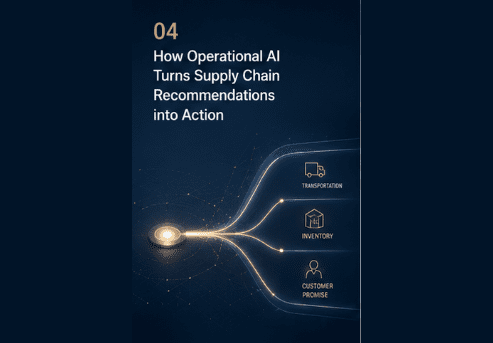
Look, AI can’t live in a vacuum. It needs to talk to your ERP. Your TMS. Your WMS. Your procurement platform. Your supplier portals. Without these connections, AI is just a very expensive observer. It can tell you a shipment is going to miss its appointment. Big deal. An operational AI would see that, calculate the downstream impact, find an alternative carrier, check the cost, get an approval if needed, and update customer service. That’s operational intelligence. That’s the difference between a whisper and a shout.
Human Judgment Isn’t Obsolete. It’s Tiered.
Now, does this mean every AI recommendation should trigger an automatic, no-questions-asked action? Absolutely not. Supply chain decisions are messy. They involve tradeoffs. Cost versus service. Risk versus speed. Customer relationships. Human judgment is still paramount. The real prize is tiered autonomy. Low-risk stuff? Automate it. Moderate risk? Get a planner’s sign-off. High-impact disasters? Escalate to the C-suite. A well-designed system knows when to act, when to ask, and when to panic.
Learning from Mistakes (And Successes)
And this is where the real magic happens. The feedback loop. Did that expedited shipment save the day? Did the alternate supplier actually deliver on time? Did rebalancing inventory cause a different problem elsewhere? These outcomes shouldn’t vanish into the ether. They need to feed back into the AI. This is how AI stops being a static tool and becomes a truly dynamic, learning system. It gets smarter with every decision, every outcome. It learns. It adapts. It actually becomes useful. Anything less is just hype.
So, before you buy into the latest AI buzz, ask the hard questions. Does it integrate? Can it act? Can it learn? If the answer is anything less than a resounding ‘yes,’ you’re probably just buying a very expensive flashlight for a dark room.