DSV’s Big Bet: Moving from ‘Off-the-Shelf’ to Own-the-Shelf
Get this: DSV, the titan of global freight forwarding, is pulling the plug on CargoWise. Not a gradual phasing out, mind you, but a full-blown, confirmed pivot towards its own in-house systems – Tango and Star. This isn’t just a software upgrade; it’s a fundamental platform transformation, announced with considerable fanfare at their Capital Markets Day. We’re talking about a wholesale embrace of AI and proprietary tech as the new bedrock of their operations.
One System to Rule Them All
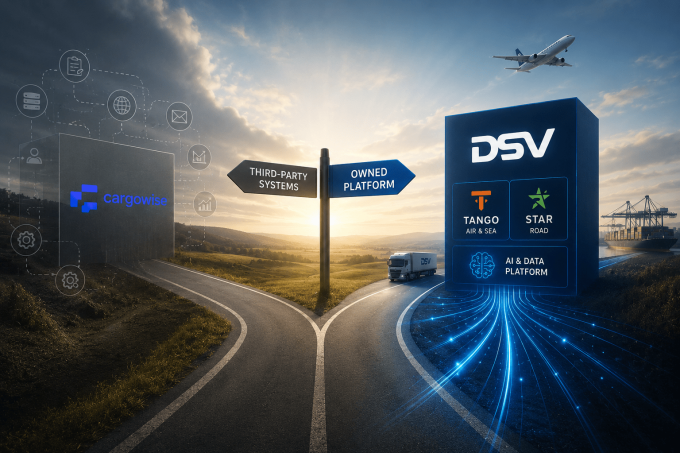
For years, CargoWise has been the undisputed heavyweight champion of forwarding software, a go-to for giants. But DSV’s new gospel? “One process, one system, count to one.” Their target architecture slide was stark: Air & Sea moving from “2 TMSs” to a single TMS, with CargoWise One explicitly crossed out and replaced by Tango. Road division? Star will be the sole operator, swallowing over 25 existing systems. This isn’t just tidying up; it’s a strategic nuclear option aimed at ultimate control and efficiency.
DSV said it was “moving from off-the-shelf to owned core systems”, adding that long-term ownership was “cheaper, faster, and more resilient than off-the-shelf solutions – and reducing dependencies on third-party providers”.
This statement alone will send shivers down the spine of software vendors everywhere. It’s a clear declaration of independence, a message that commoditized software is no longer the future for the world’s biggest players. They’re building their own digital kingdom, brick by proprietary brick.
The AI Engine Roars to Life
And what’s fueling this monumental shift? Artificial Intelligence. DSV is projecting a jaw-dropping Dkr6bn ($870m) in annual AI and technology-related improvements by 2030, directly tying this bounty to their migration to Tango and Star. They’re not just adopting AI; they’re building an entire ‘AI Factory’ designed to centralize data and enable reusable AI services across all their divisions – Air & Sea, Road, and Contract Logistics. Think of it as a massive, intelligent brain for the entire DSV organism, constantly learning and optimizing.
This is the fundamental platform shift everyone has been talking about. AI isn’t just an add-on feature anymore; it’s the core operating system, the foundational layer upon which everything else is built. It’s like the invention of electricity – it didn’t just power existing machines; it enabled entirely new ones and reshaped industries.
Is This the End of CargoWise’s Reign?
If DSV, one of CargoWise’s most significant enterprise clients, can successfully migrate its substantial volumes to in-house systems, it could be a watershed moment. This move might embolden other major forwarders, who’ve perhaps been quietly contemplating their own platform dependencies, to seriously re-evaluate their long-term reliance on third-party software. The economics of enterprise software are changing dramatically with AI, and vendors who don’t adapt are going to find themselves on shaky ground.
Remember the early internet? Companies clinging to their proprietary, siloed systems got left in the dust when the web provided a universal platform. This feels like a similar inflection point for logistics technology.
What About the Other Players?
One anonymous tech executive put it starkly to The Loadstar: “People are running for the exi”. This isn’t just about WiseTech Global, the maker of CargoWise. It’s a signal to the entire ecosystem of logistics software providers. As major players like DSV invest heavily in their own AI-driven platforms, the landscape will inevitably shift. Will we see a wave of consolidation among software vendors, or perhaps a rise in open-source initiatives that can compete with the proprietary giants?
DSV’s commitment to Tango isn’t just about cost savings; it’s about building resilience and agility. In a world where supply chains are constantly tested, having control over your core technology stack is becoming a strategic imperative. This is more than just a TMS change; it’s DSV betting its future on an AI-powered, self-built digital infrastructure.
Why Does This Matter for the Supply Chain?
This shift by DSV isn’t just an internal IT decision; it has ripple effects across the entire global supply chain. When a logistics behemoth like DSV decides to build its own integrated AI platform, it signals a broader trend towards vertical integration and proprietary technology in the industry. This can lead to more streamlined operations, faster innovation, and potentially more tailored solutions for clients. However, it also raises questions about interoperability and the competitive landscape for independent software providers. For businesses that work with DSV, this could mean more efficient transactions, better visibility, and a more responsive service – all driven by intelligent automation. It’s a peek behind the curtain at the future of digitized logistics.
🧬 Related Insights
- Read more: What is Demand Forecasting?
- Read more: Supply Chain Risk Management: A Framework for Building Resilience
Frequently Asked Questions
What does DSV’s shift from CargoWise mean for other freight forwarders?
It suggests that large forwarders may increasingly look to develop or acquire in-house technology platforms, reducing reliance on third-party software. This could spur a trend of greater technological independence and AI-driven innovation within the industry.
Is DSV completely abandoning CargoWise immediately?
No, the transition is phased. Approximately 25% of Air & Sea volumes are already on Tango, with a broader rollout beginning in 2027 after further upgrades. This indicates a strategic, albeit determined, migration rather than an abrupt cut-off.
What is the ‘AI Factory’ DSV is building?
DSV’s ‘AI Factory’ is designed to centralize operational data across its various divisions. This will enable the company to develop and deploy AI services more effectively at an enterprise scale, driving productivity and cost improvements.