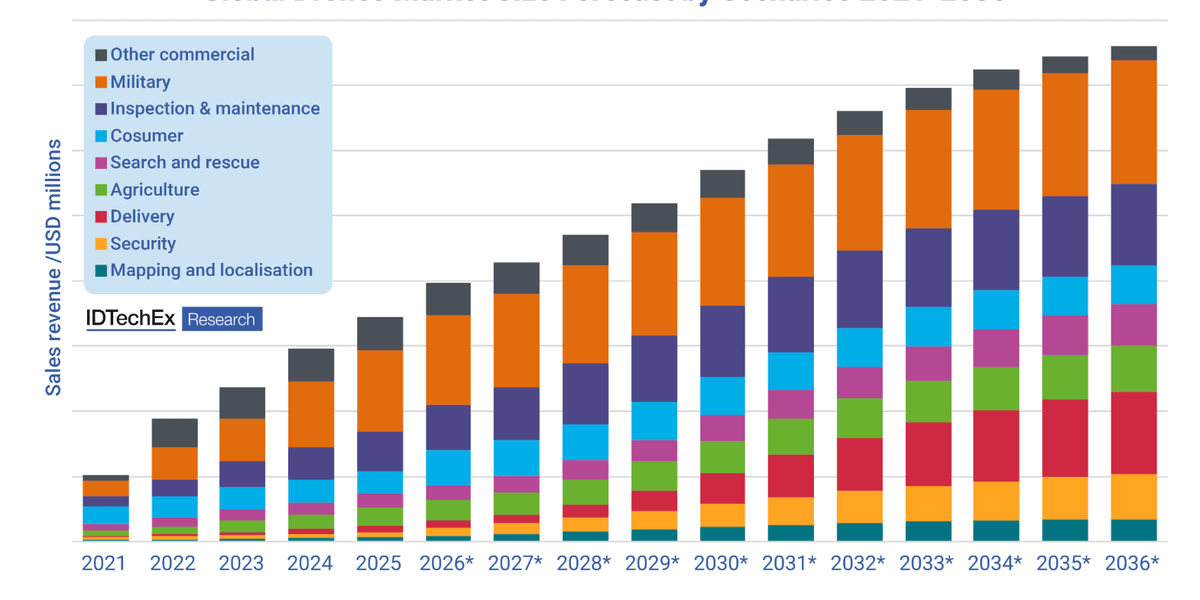
Nine million units. That’s the projection from IDTechEx for annual commercial drone shipments by 2036. Let that sink in. We’re not talking about hobbyist toys here; we’re talking about a fundamental platform shift that’s about to reshape entire industries. It’s like going from the Wright brothers’ first hop to the dawn of commercial aviation, all within a couple of decades.
The Age of the Operational Drone is Here
For years, drones have been the tech equivalent of a brilliant student with a stack of overdue assignments – lots of potential, but stuck in the theoretical phase. We’ve seen countless pilot projects, endless validations, and shiny presentations about what could be. But now? Now, the rubber is meeting the road, or perhaps more accurately, the rotors are meeting the sky with a concrete purpose: delivering measurable value. Think safe flight, precise data collection, and ticking off those repeatable operational goals that make businesses actually care.
This isn’t just an incremental upgrade; it’s a wholesale metamorphosis. We’re witnessing drones transition from a ‘nice-to-have’ gadget to an essential tool, integrated deeply into the fabric of supply chain operations.
Delivery Drones: Beyond the Hype
The delivery sector is absolutely buzzing, with everyone from your favorite retailer to critical healthcare networks eyeing drone capabilities. IDTechEx pegs drone delivery revenue to explode from a modest $2.2 billion in 2026 to a jaw-dropping $25.3 billion by 2036. That’s a nearly 12x leap!
But here’s the critical nuance that separates the enthusiasts from the pragmatists: we’re not looking at Amazon Prime dropping off a new toaster oven anytime soon. The real action, at least initially, is in the high-value, time-sensitive niches. Imagine urgent medical supplies zipping across town, bypassing gridlocked traffic. Think critical pharmacy deliveries for remote communities. Drones offer an unparalleled advantage when every second counts and roads are an insurmountable obstacle. They’re not just faster; they’re life-savers and problem-solvers in areas where conventional methods falter.
Of course, it’s not all smooth sailing. The regulatory landscape is still a complex maze. Beyond Visual Line of Sight (BVLOS) approvals, public trust, and the sheer economics of a flight path – these are the dragons every drone delivery company needs to slay. Large-scale deployment demands more than just a flying machine; it requires automated loading docks, sophisticated landing systems, intelligent fleet management, and strong detect-and-avoid technology that plays nice with existing logistics.
So, expect to see these delivery drones populating defined corridors, suburban areas, and crucial medical networks first, before they flood the dense urban cores. It’s a strategic rollout, not a chaotic free-for-all.
Agriculture and Inspection: The Clear ROI Plays
While delivery captures the headlines, agriculture and inspection drones are quietly but powerfully demonstrating their worth. In agriculture, the value proposition is crystal clear: less manual labor, more precise spraying (meaning less wasted chemicals and a greener footprint), and a constant stream of field data that helps farmers make smarter decisions. It’s precision agriculture reaching its logical, automated conclusion.
But perhaps the most compelling ROI story belongs to inspection and maintenance. Drones are becoming the eyes and hands for inspecting everything from towering wind turbines and sprawling power lines to sensitive pipelines, vast solar farms, and critical infrastructure like bridges. This isn’t just about saving on labor costs; it’s about slashing downtime, drastically reducing safety risks for human inspectors, and getting a level of detail and frequency of inspection that was previously unimaginable. Think of it as giving inspectors superhero vision and super-speed.
A Historical Parallel: The Internet’s Shadow
This feels, to me, uncannily like the early days of the internet. Remember when it was a novelty, a tool for academics and enthusiasts? Then came the browsers, the dial-up modems, and suddenly, the entire world began to connect. AI, and the automation it enables, is that same kind of fundamental platform shift. Drones, powered by AI and advanced sensing, are simply one of the most visible manifestations of this new era. They’re not just flying robots; they’re mobile data-gathering, task-executing extensions of our increasingly intelligent digital world. The old constraints of physical location and human limitation are starting to dissolve. It’s a wild ride, and we’re only just beginning to see the true potential unfold.
🧬 Related Insights
- Read more: What is a Bill of Lading?
- Read more: De Minimis Tariff Refunds Rejected: US Justice Dept. Says No
Frequently Asked Questions
Will drones replace human delivery drivers? While some delivery roles may be impacted, the focus is currently on augmenting human capabilities and addressing labor shortages in specific, time-sensitive, or hazardous delivery scenarios. Drones are more likely to complement than completely replace human drivers in the short to medium term, especially in complex urban environments.
Are drones reliable enough for critical deliveries like medicine? The industry is moving towards operationalizing drones for critical deliveries by focusing on safety, redundancy, and regulatory compliance. Technologies like advanced navigation, detect-and-avoid systems, and secure landing protocols are being developed to ensure reliability for high-stakes missions.
What is the biggest challenge facing widespread drone adoption? The biggest challenges are regulatory hurdles, particularly around Beyond Visual Line of Sight (BVLOS) operations, airspace management, and public acceptance. Economic viability for broad-scale deployment, along with the integration into existing logistics infrastructure, also remain significant factors.